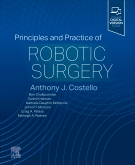
Robot-assisted surgery, soon to be incorporated into most surgical disciplines, can reduce postoperative complications by up to 50%, and has been shown to result in reduced blood loss, earlier hospital discharge, and faster return to normal activity for the patient. Edited by master surgeon Tony Costello, and with contributions from the world’s best and most experienced robotic surgeons worldwide, Principles and Practice of Robotic Surgery is an up-to-date, all-in-one reference that provides step-by-step instruction for practicing surgeons and those who are entering robotic surgery training. This first-of-its-kind text discusses new technologies and their application in each surgical subspecialty, with hundreds of outstanding illustrations and high-quality videos—making this an ideal resource for the entire OR team.
General principles
- Anesthesia for robotic surgery
- Physiology of pneumoperitoneum
- Complications
- Preoperative assessment and patient selection
- Patient positioning and prevention of injury
Bedside – including port placement and docking
- Draping robot
-
- (basic understanding in order to be able to deal with trouble shooting)
- Need all 4 arms to be draped even if not using
- Port placement
-
- Establishing pneumoperitoneum
-
- Hasson
- Veress
- Optical
- Insufflation pressure
-
- Complications and trouble shooting
- Eg. Adhesions, Obesity, Narrow pelvis, Prior surgery or radiotherapy, Existing stoma
- Docking the robot
-
- Modelled on Device teaching
-
- Targeting
- Ensuring adequate space between arms
- Burping
- Safety
-
- e.g. height limitation
- Locking instruments to avoid drift
- Emergency undocking
- Trouble shooting errors and faults
- Instruments
-
- Familiarity with commonly used laparoscopic instruments for the bedside assistant
- Inserting and exchanging instruments
Console
- Diathermy settings
- How does it all work?
-
- Basic rundown of buttons etc
- Controlling the camera
-
- Use of different lenses and changing view
- Understanding when/why to use different lens
-
- Swapping between instruments
- Fourth arm control
- Clutching
- Customising your setup
- Ergonomics
- Scaling ratio movement
-
- Adjusts movement speed to surgeon preference
- Default 3:1, 2:1, 1.5:1
-
- Available instruments
- Diathermy settings
OPERATING
Basic surgical skills on the console
- Haptics
- Wrist movements
- Understanding how the system works and how optimise use
- Grasping objects
- Passing items between hands
- Cauterising
- Knot tying
- Suturing
-
- Dissection and developing tissue planes
- Emergency management
-
- Vascular emergency
- ??other essential crisis management
- Trouble shooting
-
- Use instrument out of view visual cues
- Only works if foot is on camera pedal
-
- Switch dominant eye if smudge only on one side
- Can adjust zoom if tissue close and there is spatter/diathermy smoke issue
Surgical skills for the bedside assistant
- Fundamental laparoscopic skills
-
- Safe instrument handling
- Suctioning
- Clipping
- Stapling
- Cutting
- Specimen extraction
- Trouble shooting
-
- Loss of pneumoperitoneum
- Port loss (inadvertent removal)
- Port site closure
- Undocking robot
Advanced aspects of operating
- Haemostatic agents
- Stapling
- Fluorescence imaging
- Tilepro
Simulation Training for Robotic Surgery
- Communication and human factors
-
- Team based training
- Operating room communication
- Virtual Reality Simulator Training
- Procedural Training
-
- 3D printed synthetic human organ hydrogel models (this model may soon replace animal and cadaver training in robotics)
- updates could be included with scannable QR codes and searchable web links. These links will provide access to the latest instructional content for the major robotic surgery systems
SPECIALTY SPECIFIC OUTLINE
For each specialty…
- Other fundamental skills not covered in basic course?
- Core procedures
- For each core procedure:
-
- Approach(es)
- Equipment required
- Patient positioning & operating room setup
- Port placement
- Docking
- Step by step procedure guide – operative steps/technique
- Particular specialised skills required for this procedure
Nephrectomy partial nephrectomy pyeloplasty, intrarenal stone surgery, in surgery, nephroureterectomy, cystectomy, cystoprostatectomy, radical prostatectomy, retroperitoneal node to section.
Hernia surgery including incisional hernia and mesh hernia repair. Colorectal cancer surgery. Upper gastrointestinal surgery including obesity surgery antireflux surgery and gastric surgery. Pancreatic surgery. Appendicectomy and gallbladder surgery.
Hysterectomy oophorectomy endometriosis surgery
Radical hysterectomy radical ovarian surgery and retroperitoneal node to section
Sacrocolpopexy /incontinence surgery
Mitral valve repair/replacement
Floor of mouth tonsillar vocal cord surgery
Lobectomy, lung cancer surgery, thyroid surgery, diaphragmatic surgery, flexible endobronchial surgery
- Urology
- General surgery
- General gynaecology and gynaecology Oncology
- Cardiac surgery
- ENT surgery
- Thoracic surgery
- Endoscopic flex robotics for oesophageal and gastric surgery performed by gastroenterologists (a new market)